Cognitive Kin: How to Work, Win, and Make Meaning with Agentic AI - Book Review
Cognitive Kin: How to Work, Win, and Make Meaning with Agentic AI
Author:
Christophe Kolb
Genre: Nonfiction Business/Finance Publisher: Ideapress Publishing Date Published: March 1, 2026
ISBN-10: 1646872126
ISBN-13: 978-1646872121
|
Book Review of : Cognitive Kin: How to Work, Win, and Make Meaning with Agentic AI
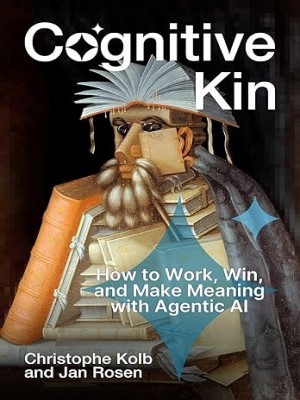
In Cognitive Kin, Christophe Kolb and Jan Rosen provide a visionary yet deeply grounded field guide for the "Agentic Revolution". The book’s central thesis is that artificial intelligence is undergoing a monumental shift from generative tools that respond to prompts to autonomous agents that proactively pursue goals. This transition from "autocomplete to complete autonomy" marks the dawn of cognitive kinship, where humans and AI co-evolve as partners rather than mere operators and instruments.
The authors organize their inquiry into twenty comprehensive parts, bridging the gap between technical execution and philosophical meaning. They introduce the ASAP (At Scale Agentic Production) framework, a new methodology designed to replace Agile’s human-centered rhythms with protocols suitable for agents that "never sleep". This practical approach is reinforced by a "Leader’s Playbook" at the end of every chapter, designed to help readers translate complex concepts like "Goal Graph Organizations" and "vibe working" into actionable practice.
Cognitive Kin is exceptionally relevant today for several critical reasons. First, it addresses the productivity paradox by explaining why individual gains in artificial intelligence have not yet translated into macro-level improvements within organizations. The authors provide a blueprint for "recoding the enterprise" to unlock true scale and enhance productivity. Moreover, the book discusses navigating the organizational metamorphosis brought about by AI, which dissolves traditional boundaries. It introduces the concept of the "Post-Firm," where rigid hierarchies are replaced by fluid, self-organizing alliances that adapt to new challenges and opportunities.
In addition to these insights, Cognitive Kin offers a strategic framework for leadership. Rather than treating AI as merely a technical update, the authors frame it as a profound leadership shift. This perspective helps executives move beyond the simplistic "love/hate binary" often associated with AI discourse, encouraging them to adopt an "Agentic Humanist" stance. This approach focuses on ethics and intentional design in the deployment of AI technologies.
Kolb and Rosen elevates its discussion by weaving in the insights of philosophical thinkers like Wittgenstein, Nietzsche, and Kant. This philosophical depth shifts the conversation from mere efficiency to important considerations of meaning-making, energy ethics, and the question of machine consciousness.
Ultimately, the authors argue that our challenge lies not in competing with AI agents but in crafting partnerships grounded in shared goals. Cognitive Kin is an essential read for anyone looking to lead deliberately through the significant transformations that AI represents—changes that are arguably the most consequential since the advent of the internet.
Reviewed by: David H.
|
About Christophe Kolb

Dr. Christophe Kolb is the founder and CEO of Taller, a global accelerator for digital transformation that brings AI and deep tech from incubation to large-scale deployment. He works with Fortune 500 companies and ambitious enterprises to build 'centaur workforces': hybrid teams of human specialists and AI agents that redefine how organizations create, deliver, and capture value. A longtime traveler across the frontiers of advanced technology - from neural networks and decentralized systems to quantum computing. Kolb holds a Ph.D. in Computation & Neural Systems from Caltech and a degree in Physics & Philosophy from Oxford. Jan Rosen is Chief Innovation and Transformation Officer at Taller, where he designs and deploys agentic AI architectures that change how organizations think, decide, and deliver. Before joining Taller, he led major engineering efforts at Venmo and PayPal, building the invisible machinery behind everyday payments and in-store experiences, and driving major platform modernization. A systems engineer by training and temperament, he moves easily from code to culture, helping enterprise leaders translate advanced strategy into running software. Rosen holds an MSc. in Computer Science from Chalmers University of Technology.
Comments
No comments submitted.
Be the first to comment on this book.